

Modern manufacturing is increasingly driven by data rather than isolated production events. While inspection equipment was once positioned primarily as a final quality gate, today’s automated inspection machines have evolved into strategic data acquisition platforms that support process optimization, predictive maintenance, and continuous improvement initiatives across the factory floor.
Every inspected component generates valuable production intelligence, including image records, dimensional measurements, defect classifications, process timestamps, and statistical quality indicators. When properly integrated into a connected manufacturing environment, this information provides visibility far beyond simple pass-or-fail decisions.
Instead of merely identifying defective products, manufacturers can use inspection-generated data to uncover process inefficiencies, reduce scrap rates, improve equipment utilization, and strengthen overall production consistency.
Inspection Systems as Manufacturing Data Nodes
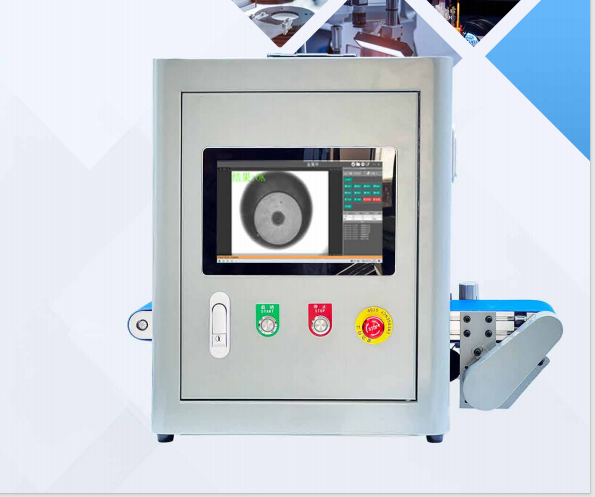
In a smart factory environment, inspection systems serve as critical endpoints within a broader digital infrastructure. High-speed cameras, sensors, and measurement devices continuously capture operational data, creating a real-time feedback mechanism between production equipment and quality management systems.
The effectiveness of this approach depends not only on image acquisition accuracy but also on the ability to transmit and analyze inspection results across enterprise-level platforms. Integrating machine vision inspection systems with centralized databases enables manufacturers to transform isolated quality checks into actionable operational intelligence.
As Industry 4.0 adoption accelerates, inspection machines are increasingly connected with production monitoring software, allowing quality data to influence upstream manufacturing decisions in real time.
Industrial Communication Protocols and Data Connectivity
For inspection equipment to function effectively within a connected production ecosystem, reliable communication with Manufacturing Execution Systems (MES), Enterprise Resource Planning (ERP) platforms, and industrial control networks is essential.
Several communication standards have become widely adopted across industrial environments:
OPC UA (Open Platform Communications Unified Architecture)
OPC UA has emerged as a leading interoperability standard in industrial automation. It enables inspection systems from different manufacturers to exchange structured production and quality data with supervisory control platforms, eliminating many compatibility challenges commonly associated with legacy equipment.
Through OPC UA integration, inspection results, defect statistics, and machine performance indicators can be transmitted directly to plant-wide monitoring systems.
MQTT (Message Queuing Telemetry Transport)
For Industrial Internet of Things (IIoT) deployments, MQTT offers a lightweight and efficient communication framework. Inspection machines can publish real-time operational information—including inspection throughput, machine health metrics, alarm conditions, and environmental monitoring data—to multiple subscribers across the factory network.
This architecture supports scalable deployment across multiple production lines and facilities.
REST APIs and Cloud-Based Analytics
Modern inspection systems increasingly support REST API connectivity, allowing manufacturers to transfer aggregated inspection data to cloud-based analytics platforms.
Cloud integration enables centralized monitoring of geographically distributed facilities, facilitating cross-site benchmarking, trend analysis, and standardized quality reporting.
Network Infrastructure Considerations
High-resolution imaging systems generate substantial volumes of data. Depending on camera resolution, frame rates, and inspection complexity, a single production line may produce several gigabytes of image data every minute.
Manufacturers deploying advanced industrial vision inspection systems should ensure sufficient network bandwidth, low-latency communication, and secure data storage architecture to prevent transmission bottlenecks during continuous operation.
Defect Detection Technologies: Rule-Based Algorithms vs Deep Learning
The analytical capabilities of an inspection system depend largely on the software architecture used to interpret visual information. Historically, manufacturers relied on deterministic rule-based algorithms. Today, many facilities are incorporating artificial intelligence and deep learning technologies to address increasingly complex inspection requirements.
Understanding the strengths and limitations of each methodology is essential when selecting an inspection strategy.
Rule-Based Vision Inspection
Traditional rule-based systems operate according to predefined mathematical criteria established by engineers.
For example, a scratch may be identified as a dark linear feature exceeding specific pixel dimensions. Every rejection occurs because a measurable threshold has been violated.
This approach offers exceptional transparency and predictability, making it highly effective for:
- Dimensional measurement
- Edge detection
- Barcode verification
- Optical Character Recognition (OCR)
- Alignment validation
Because decision logic is explicitly defined, operators can quickly determine why a component was rejected.
However, rule-based systems often struggle when product appearance varies naturally or when environmental conditions introduce unpredictable visual changes.
Deep Learning and AI-Powered Inspection
Unlike traditional algorithms, deep learning models do not rely on manually programmed defect rules. Instead, they learn inspection criteria through exposure to large datasets of labeled images.
By analyzing thousands of acceptable and defective samples, neural networks identify subtle visual patterns associated with defects that may be difficult to describe mathematically.
AI-powered inspection is particularly effective for:
- Surface defect detection
- Texture analysis
- Cast metal inspection
- Textile manufacturing
- Food and agricultural processing
- Cosmetic quality evaluation
These applications frequently involve natural variations that cannot be reliably addressed through conventional programming methods.
Comparative Analysis
| Inspection Method | Configuration Requirements | Best Use Cases | Primary Limitations |
|---|---|---|---|
| Rule-Based Vision | Manual programming of inspection parameters | Gauging, OCR, alignment verification, dimensional inspection | Limited adaptability to unexpected visual variations |
| Deep Learning Inspection | Large annotated image datasets and model training | Surface anomaly detection, texture analysis, complex appearance evaluation | Higher computational requirements and reduced decision transparency |
From Quality Inspection to Predictive Maintenance
One of the most significant advantages of connected inspection systems is their ability to support predictive maintenance strategies.
Rather than treating defects as isolated events, manufacturers can aggregate inspection results over weeks or months to identify gradual performance shifts within upstream equipment.
For example, if an inspection machine consistently measures a slow increase in dimensional variation from a CNC machining center, the trend may indicate progressive tool wear. Maintenance personnel can schedule tool replacement before production exceeds tolerance limits, preventing costly scrap accumulation.
This data-driven feedback loop transforms quality control from a reactive process into a proactive manufacturing optimization strategy.
As more facilities adopt predictive maintenance solutions, inspection data is becoming a key contributor to equipment reliability programs and operational efficiency initiatives.
Hardware Considerations for Smart Factory Integration
Successful deployment requires balancing software capabilities with appropriate hardware specifications.
Key evaluation criteria include:
- Camera resolution and sensor quality
- Image acquisition speed
- Processing performance
- Lighting system stability
- Environmental protection ratings (IP-rated enclosures)
- Scalability for future production expansion
Production environments involving dust, moisture, vibration, or temperature fluctuations may require specialized hardware configurations to maintain inspection accuracy over extended operating periods.
Organizations evaluating automated quality control systems should assess both inspection performance and long-term integration capabilities to ensure compatibility with existing digital manufacturing infrastructure.
Conclusion
The role of inspection equipment has expanded significantly within modern manufacturing environments. Connected inspection systems no longer function solely as quality checkpoints; they serve as critical sources of operational intelligence that support process improvement, predictive maintenance, and production optimization.
By leveraging communication standards such as OPC UA and MQTT, integrating advanced analytics platforms, and selecting the appropriate combination of rule-based and AI-driven inspection technologies, manufacturers can establish a comprehensive quality management framework that continuously improves production performance.
Ultimately, the greatest value of modern inspection systems lies not only in detecting defects but in using inspection data to drive smarter, more efficient manufacturing operations.
Leave a Reply